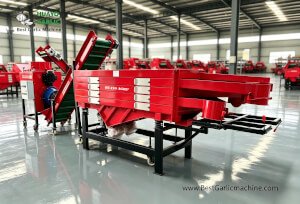
Why a 500-Acre Garlic Farm in Australia Needs the HGBS-3 Garlic Seed Splitting and Sorting Machine
For an Australian garlic grower managing around 500 acres, the biggest bottleneck before planting is often not land or machinery, but seed preparation. Garlic planting has a tight seasonal window, and every day lost to manual clove separation is a day that increases weather risk, labour pressure and scheduling uncertainty.
Australia’s agricultural labour market has become increasingly expensive and competitive. From 1 July 2026, the national minimum wage is AUD 26.44 per hour, and casual farm workers typically receive a 25% casual loading, bringing the minimum casual rate to around AUD 30.91–33.05 per hour depending on the applicable award. For large-scale garlic operations, this means manual seed preparation is no longer just a labour task — it is a major cost and risk item.
What 500 Acres Means in Practice
On a 500-acre farm, garlic seed preparation quickly reaches hundreds of tonnes. Depending on planting density, clove size and seed rate, a farm of this scale may need to handle 200–400 tonnes of garlic seed per season, or even more if the operation is expanding.
If we use a conservative estimate of 200 tonnes:
- Manual clove separation at 200–400 kg per labour hour would require roughly 500–1,000 labour hours.
- The HGBS-3 Garlic Splitting and Sorting Machine , at 3-5 tonnes per hour, can complete the same work in approximately 67–100 machine hours.
That difference is decisive during a short planting window.
Manual Labour vs HGBS-3 Machine
Why the HGBS-3 Garlic Seed Splitting and Sorting Machine Fits Australian Garlic Farms
1. It protects the planting window.
Garlic must be planted within a limited period. The HGBS-3 can process large volumes quickly, helping farms finish seed preparation before weather changes or labour shortages cause delays.
Garlic must be planted within a limited period. The HGBS-3 can process large volumes quickly, helping farms finish seed preparation before weather changes or labour shortages cause delays.
2. It reduces seasonal labour risk.
Australia’s agriculture sector relies heavily on seasonal and casual workers, and availability can be unpredictable during peak periods. Mechanising clove separation reduces dependence on large temporary teams.
Australia’s agriculture sector relies heavily on seasonal and casual workers, and availability can be unpredictable during peak periods. Mechanising clove separation reduces dependence on large temporary teams.
3. It lowers recurring cost as scale grows.
Manual separation costs rise directly with acreage. A machine investment is largely fixed, so the more seed processed each season, the lower the cost per tonne becomes.
Manual separation costs rise directly with acreage. A machine investment is largely fixed, so the more seed processed each season, the lower the cost per tonne becomes.
4. It supports more consistent seed quality.
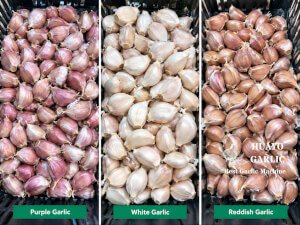
The HGBS-3 separates cloves and grades seed in one process, helping improve uniformity for mechanical or manual planting. Consistent clove size can support better spacing, emergence and crop management.
The HGBS-3 separates cloves and grades seed in one process, helping improve uniformity for mechanical or manual planting. Consistent clove size can support better spacing, emergence and crop management.
Investment Logic for a 500-Acre Grower
For a farm of this size, the HGBS-3 should not be viewed only as a piece of equipment. It is a way to:
- shorten the seed preparation period;
- reduce exposure to rising casual labour rates;
- improve scheduling certainty before planting;
- create capacity for future acreage expansion;
- turn a seasonal labour problem into a controlled mechanical process.
If a farm processes 200–400 tonnes per season, the efficiency gain is even stronger than for smaller operations. Each additional tonne processed by machine rather than by hand increases the return, because the equipment cost is spread over more output.
Recommended Next Step
For a 500-acre Australian garlic farm, we recommend starting with a site-specific cost comparison:
- expected annual garlic seed volume;
- current casual labour rate;
- available working hours per day;
- planting window length;
- power supply conditions;
- whether future expansion is planned.
With these inputs, we can provide a tailored payback estimate and a clear comparison between continuing with manual clove separation and adopting the HGBS-3 Garlic Seed Splitting and Sorting Machine. For large-scale growers, the question is usually not whether mechanisation saves labour, but how quickly it can protect the planting schedule and reduce seasonal cost pressure.